A web development contract is not paperwork for its own sake. It is the document both sides open when something goes wrong: the site is late, the client expected a feature that was never discussed, or nobody knows who has the domain password. A good contract answers these questions before they come up. Here are the clauses that matter for a small business website, landing page or online store.
1. Scope of work
The scope is the core of the contract. It should list:
- the type of project (landing page, multi-page site, online store, bot),
- the pages or sections,
- the features: forms, booking, payments, search, languages, admin panel,
- what is not included, for example copywriting, photography or paid ads.
The easiest way is to attach a brief or a specification as an appendix. If you do not have one yet, start with our website brief template.

2. Price and what it covers
A fixed price for a fixed scope is the simplest model for small projects. The contract should state the total, the currency and what happens with extra work: is it priced separately, and who approves it before it starts?
3. Payment stages
| Project size | Common payment split |
|---|---|
| Landing page | Prepayment, rest after acceptance |
| Multi-page website | Prepayment, payment after design approval, rest after acceptance |
| Online store or complex project | Payments tied to each stage |
Payment stages protect both sides: the developer is not working for free, and the client is not paying for work they have not seen.
4. Deadlines and dependencies
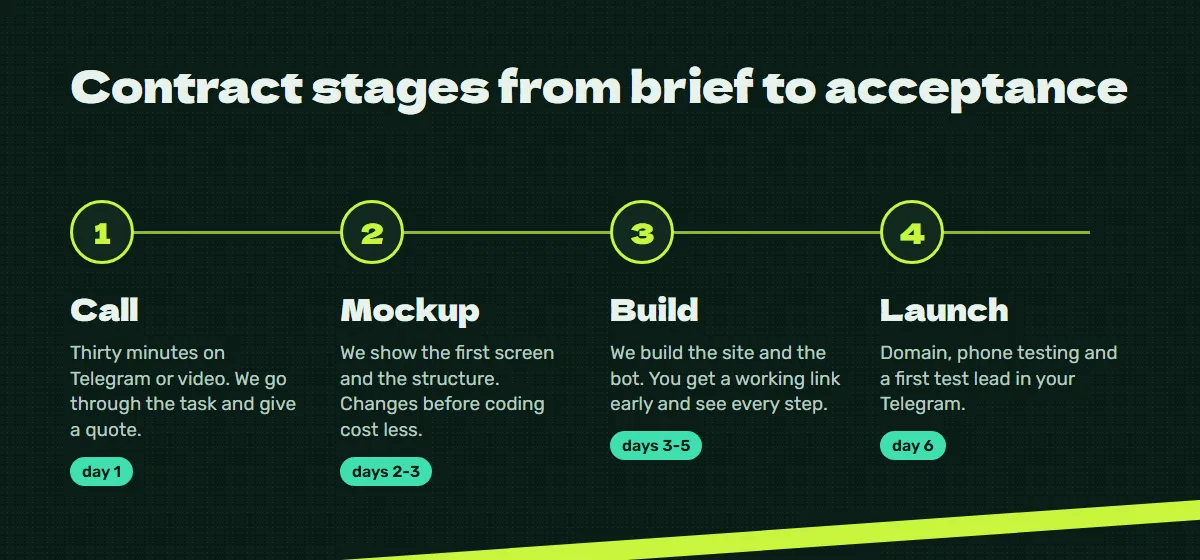
A deadline means little without dependencies. The contract should say when the clock starts (usually after prepayment and receipt of materials) and that time spent waiting for the client's texts, photos or approvals is not counted as delay. It should also say what happens if the developer is late.
For reference, Kinto's typical timings are fixed in the contract:
| Project | Price at Kinto | Typical time |
|---|---|---|
| Landing page | from $700 | about 6 days |
| Website with sections | from $1,800 | about 12 days |
| Online store | from $4,000 | about 22 days |
| Telegram bot | from $500 | depends on scenario |
5. Revisions
Agree on the number of revision rounds at each stage, for example two rounds on design and one round after launch. Without this, revisions never end. Also define what a revision is: changing a color or text is a revision, adding a new section is new scope.
6. Client materials
List what the client provides and by when: logo, texts, photos, prices, legal details, access to the domain. Many delays come from missing materials, not from development.
7. Acceptance
How does the client confirm the work is done? A practical approach: the developer delivers the site on a test address, the client checks it against the scope within a set number of days, and either signs acceptance or sends a list of issues. If the client does not respond within the period, the work is considered accepted. This clause stops projects from hanging forever.
8. Ownership of the domain, code and accounts
This clause is often missing, and it causes the most painful disputes.
- Domain registered to the business, not to the developer.
- Hosting account in the client's name, or clearly described if the developer hosts it.
- Code and design transferred to the client after full payment.
- Accounts: analytics, Google Business Profile, Telegram bot, payment provider, all owned by the client.
- Passwords handed over at acceptance.
At Kinto the domain, accounts and bots are registered to the client's business. More on this topic in our article on who owns your website.
9. Support and warranty
What happens after launch? A good contract separates:
- Warranty: fixing bugs in what was built, for a set period, free.
- Support: content updates, new features, monitoring, paid separately.
Kinto offers support from $900 for 6 months. See what support usually includes in website support: what is included.
10. Confidentiality and termination
Both sides keep each other's business information private. The contract should also say how either side can end the project early and how the work done so far is paid for and handed over.
Red flags in a contract
- No scope appendix, just "development of a website".
- The domain is registered to the developer "for convenience".
- Unlimited revisions or zero revisions.
- No acceptance procedure.
- Full payment upfront for a large project.
Next step
If you want to see how we describe scope and price, write to @kinto_am on Telegram or leave a request through the form. We will prepare a fixed quote after a short call. Our prices are on the pricing page, and the process is on the website development page.
Updated: 2026-10-15