
The marketplace vs own website decision looks simple on paper: one has buyers already, the other costs money to build. In practice the right answer depends on your margin, how often customers come back and how much control you need over price and presentation.
What a marketplace gives you
- Ready traffic. People are already searching for products there.
- Trust in checkout. Buyers know how payment and returns work.
- Logistics on some platforms: storage, delivery, returns.
- Fast start. You can list products in days.
Marketplaces, delivery aggregators and booking platforms all work this way. They are good at bringing new customers.
What a marketplace takes
- Commission on every sale, plus paid promotion inside the platform to stay visible.
- Rules you do not set: prices, returns, how your products appear, what you can say.
- The customer. The buyer remembers the platform, not your brand. Contacting them later is often limited.
- Competition on the same page. Your product sits next to similar ones, often cheaper.
- Dependence. If the platform changes fees or rules, you adapt or leave.
What your own website gives you
- No platform commission on each sale.
- Your rules: prices, bundles, promo codes, delivery terms.
- Your brand and story, without competitors next to you.
- Customer contacts for repeat orders and news, with their consent.
- Search visibility for your brand and your products.
The cost is upfront work and the need to bring visitors: ads, social media, search, a Telegram bot for regulars.
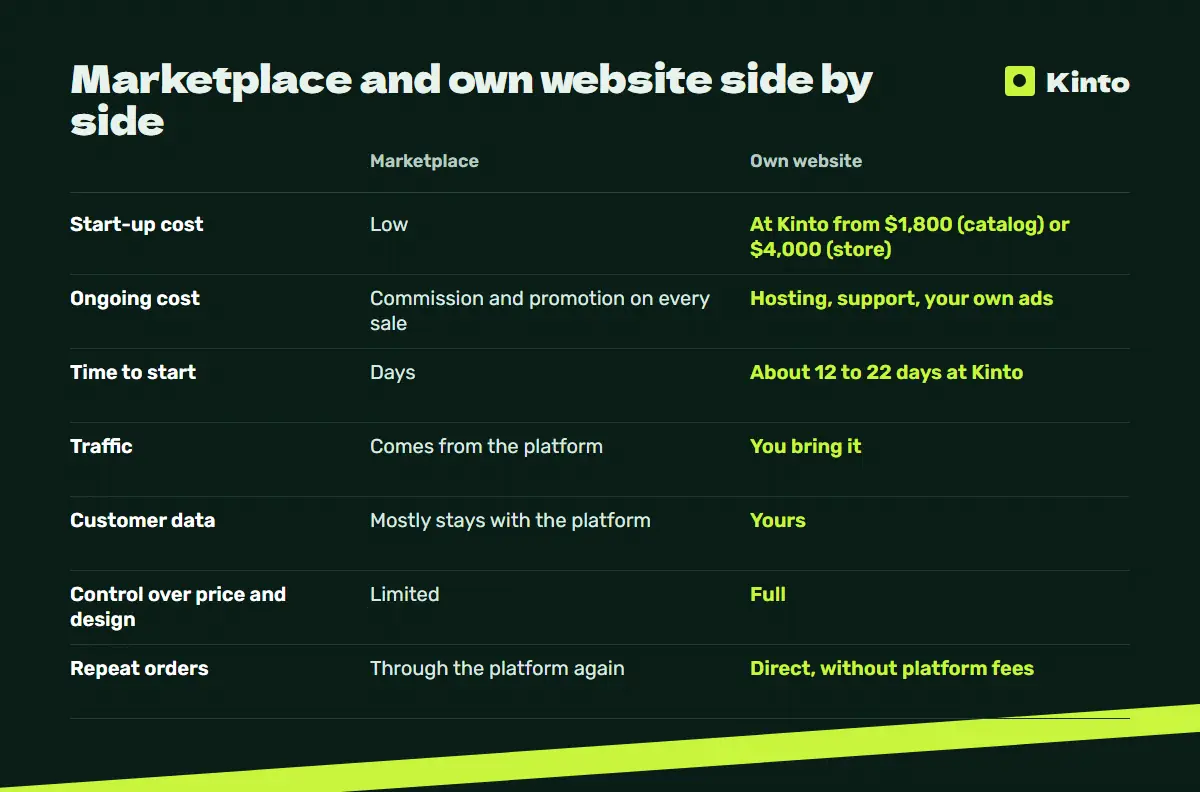
Side by side
| Marketplace | Own website | |
|---|---|---|
| Start-up cost | Low | At Kinto from $1,800 (catalog) or $4,000 (store) |
| Ongoing cost | Commission and promotion on every sale | Hosting, support, your own ads |
| Time to start | Days | About 12 to 22 days at Kinto |
| Traffic | Comes from the platform | You bring it |
| Customer data | Mostly stays with the platform | Yours |
| Control over price and design | Limited | Full |
| Repeat orders | Through the platform again | Direct, without platform fees |
When a marketplace is the better first step
- You are testing a new product and do not know if it sells.
- Your products are standard and buyers compare them mainly by price.
- You have no budget for a site and ads yet.
When your own website pays off
- Customers come back regularly: food, cosmetics, coffee, pet supplies, services.
- Your margin is thin and commissions eat most of it.
- Your product needs explanation, photos and a story.
- You sell services, bookings or custom orders that marketplaces handle poorly.
Using both
A common setup for small businesses in Armenia:
- Marketplace or aggregator for discovery.
- Insert in every package with a QR code: "Order directly next time" leading to your site or bot.
- Your own site with the full range, bundles and direct delivery.
- Telegram bot or channel for repeat orders and news.
This way the marketplace brings first-time buyers, and your site keeps them.
Store or catalog
You do not always need a full online store. A catalog with prices and an "Order" button that sends requests to Telegram is often enough for a start. See online store or catalog and online store in Armenia.
Cost at Kinto
| What | Price | Timeline |
|---|---|---|
| Catalog website with order form to Telegram | from $1,800 | about 12 days |
| Online store: cart, payment, delivery zones | from $4,000 | about 22 days |
| Online payment | $600 | added |
| Product search | from $400 | added |
| Telegram bot for repeat orders | from $500 | added |
| Support | from $900 for 6 months |
See the online store page for details.
Next step
Tell us what you sell, where you sell it now and how often customers come back. We will suggest whether a catalog, a store or a bot fits better. Write to @kinto_am on Telegram or leave a request on the website development page. We reply within 15 minutes, 10:00 to 20:00 Yerevan time.
Updated: 2026-10-15